Camera System
For cameras used in school transport, employee shuttles, minibuses, shared taxis and buses, installation scope, specifications and vehicle implementation are assessed together.

AİTM series-installation procedures must be planned correctly for camera, recording, tracking and emergency-button systems fitted to school transport vehicles, employee shuttles, minibuses, taxis, shared taxis, urban buses and coaches. Anemon Engineering manages application and certification for vehicle manufacturers, installation organisations and device manufacturers.

The AİTM Series Installation Certificate is the process through which specified systems can be installed on vehicles using a consistent technical configuration under the Turkish Regulation on the Manufacture, Modification and Assembly of Vehicles. It requires more than obtaining a certificate: installation scope must be defined correctly, TSE assessment stages managed, device suitability demonstrated and implementation made traceable.
A series-installation approach enables cameras, recording systems, vehicle tracking and emergency buttons to be implemented across different vehicles in a controlled, documented and sustainable manner.
Scope and requirements must be assessed for each project.
For cameras used in school transport, employee shuttles, minibuses, shared taxis and buses, installation scope, specifications and vehicle implementation are assessed together.
For video-recording systems, the recorder, storage architecture, connections and post-installation traceability are important parts of the application.
Vehicle-tracking installations must align device position, electrical connection, data communication and intended use with the applicable process requirements.
Emergency-button projects require a project-specific assessment of accessibility, operation, system integration and installation suitability.
For school transport, camera, recording and emergency-button systems are assessed together with their technical conformity.
For employee shuttles, installation scope, device selection and application documents must align with the vehicle’s intended use.
In minibuses, camera, tracking and recording systems are assessed in relation to vehicle class, operating scenario and existing electrical architecture.
For taxis, device installation, visibility, operating continuity and in-vehicle equipment layout are important process considerations.
For shared taxis, the public-transport use case and the effect of devices on the vehicle must be assessed together.
On urban buses, multi-camera, tracking and recording systems must be planned with fleet management and technical traceability in mind.
For coaches, system integration, recording continuity and installation organisation must be clarified during the application.
Installed systems are expected to support operational safety and improve control of in-vehicle operations.
Technical compatibility between the device, installation method and vehicle structure must be assessed before application.
A series-installation approach makes it easier to record which device is installed in each vehicle and how.
The objective is to make the same installation repeatable and controllable across different vehicles.
Structured management of application, review and conformity reduces revisions and lost time.
Application, certification, installation organisation, conformity and technical follow-up should be planned as one process. For installations repeated across multiple vehicles, defining the correct scope is essential to a controlled outcome.
Camera, recording, tracking and emergency-button systems require technical assessment, documentation and process support. Device manufacturers must participate with an accurate information set.
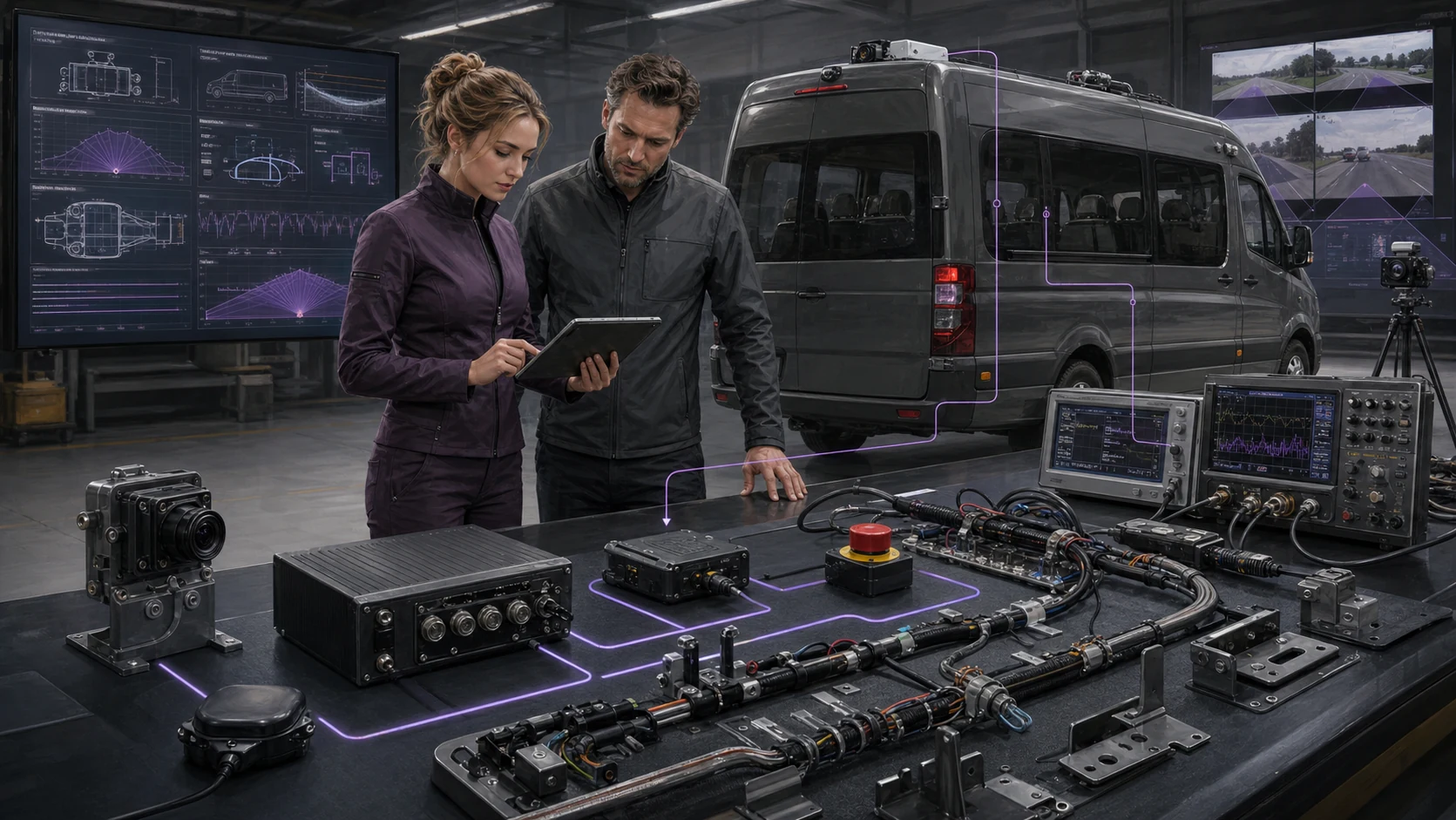
The installation-suitability report is an important element in assessing a device for the relevant vehicle and installation. It clarifies device specifications, system validation, documentation requirements and the device’s role in the application.
Without the correct technical evidence for cameras, recording systems, vehicle tracking or emergency buttons, the application may require unnecessary revisions.
Vehicle type, device scope, installation method and application requirements are assessed together.
Technical documents, device information, installation descriptions and conformity records are organised.
The application scope is established and the relevant authority procedures are followed in a structured manner.
Technical questions and revision requirements arising during TSE assessment are managed.
Once conformity assessment is complete, the certificate structure and scope are checked.
Traceability, records and change management are maintained across series applications.
Vehicle group, device type, installation scope and application strategy undergo a technical pre-assessment.
Device specifications, installation descriptions, the conformity report and application set are organised into a coherent structure.
The AİTM series-installation application is prepared with the correct scope and followed through the relevant stages.
Clarifications, revisions and technical responses required during TSE assessment are managed for the specific project.
Support is provided to present a coherent evidence structure during technical review and certification.
After certification, process discipline is established for installation organisation, changes and series-application records.
Missing device specifications, installation descriptions or conformity records create revision requirements during the application.
If application scope does not match the vehicle group and installation, the process may lose time.
If device selection and installation method are reviewed too late, the implementation may need to change.
Failing to plan the installation flow for series applications from the outset weakens traceability.
The process cannot progress if the camera, recording, tracking or emergency-button system is not technically suitable.
Failure to follow the application, TSE review and certification stages systematically can cause unnecessary delays.
Professional support in the AİTM series-installation process helps identify technical requirements early, strengthen documentation and manage TSE assessment stages with greater control. Current official information is also available on the TSE application page for the AİTM Series Installation Certificate and Installation-Suitability Report where the authority publishes its latest notices.
Because vehicle group, device type and installation scope vary, every application must be assessed on its own merits.
The AİTM Series Installation Certificate is the application and certification process that enables specified device or system installations to be repeated within a consistent technical scope and traceability structure.
For camera installations, device specifications, vehicle position, connection architecture, documentation and application scope are assessed together.
Depending on project scope, device information, installation descriptions, technical conformity records, a suitability report and application documents may be required.
For vehicle-tracking systems, device compatibility with the vehicle, installation method, data communication and role within the application are assessed.
For emergency buttons, device operation, accessibility, electrical connection and suitability for installation are reviewed technically.
The installation-suitability report is a key part of the technical assessment and evidence demonstrating that a device can be used in the specified installation.
Depending on project scope, vehicle manufacturers, installation organisations, device manufacturers and suppliers may participate in the process.
Device manufacturers support the technical-data, conformity and documentation requirements for cameras, video recorders, tracking systems and emergency buttons.
Anemon Engineering supports pre-application assessment, technical documentation, application management, TSE process follow-up, certification and post-installation process management.
Let us assess the technical support required for your AİTM series-installation project covering cameras, video recorders, vehicle tracking and emergency buttons.