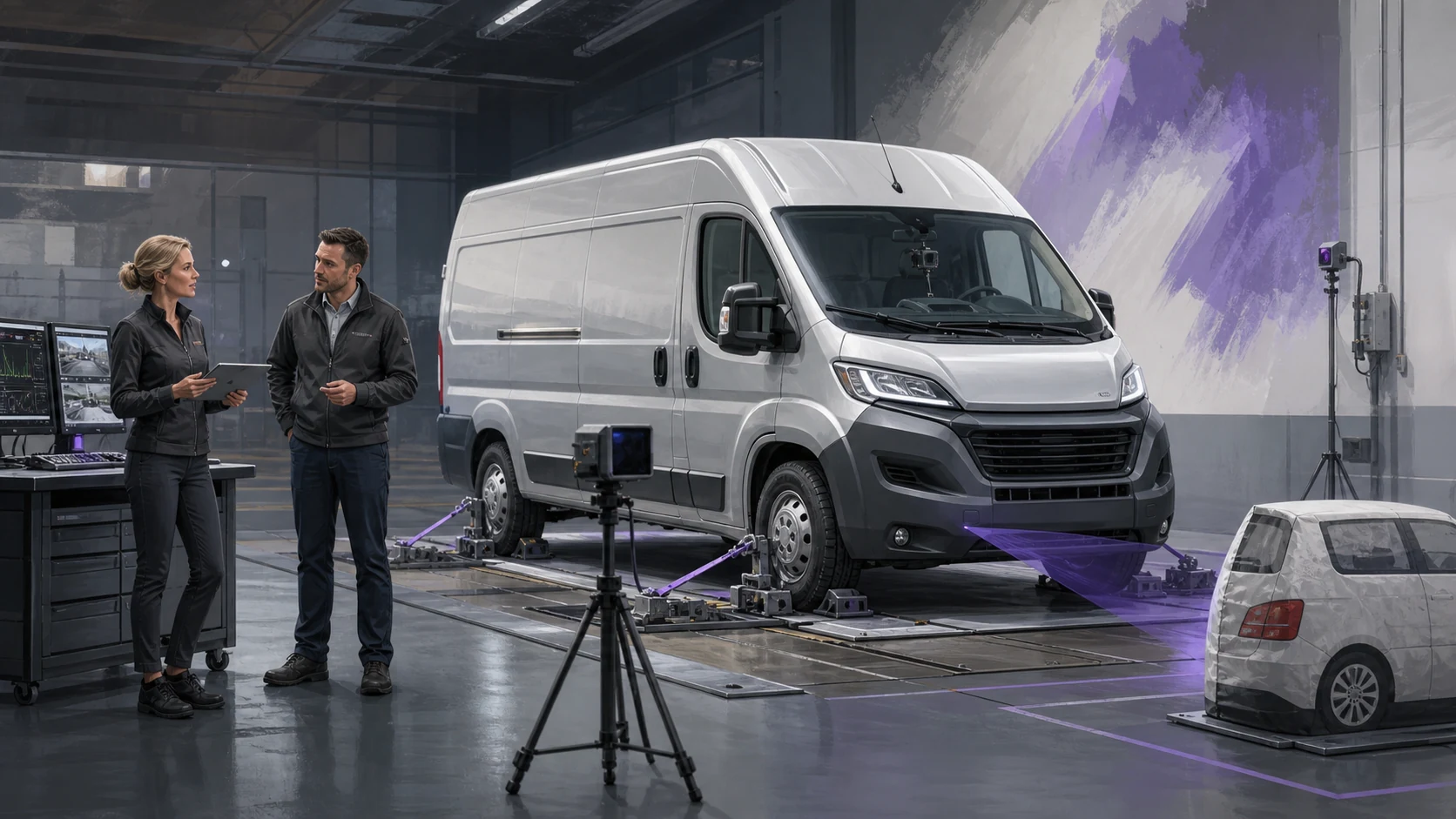

GSR II should be understood as the revised framework for general vehicle safety requirements. Through a series of measures, the European Union has defined how manufacturers must address vehicle type-approval processes, including approvals such as cybersecurity type approval.
IMPORTANT NOTICE: Under Official Gazette No. 32799 dated 31 January 2025, the application of GSR II requirements to AİTM series conversions, individual conversions and installation procedures for M2, M3, N2 and N3 category vehicles has been postponed until 1 October 2025. Manufacturers must use this period to achieve full compliance with the GSR II requirements. Contact us for further information and support with GSR II compliance.
The GSR II transition in the bodybuilder sector has exposed a significant challenge. Read our detailed assessment of the issues facing bodybuilders.
What Is GSR II – General Safety Regulation II?
For vehicles to obtain type approval, they must comply with regulations established by the European Union. These regulations are updated at defined intervals.
GSR II is a far-reaching update that requires vehicles to incorporate a new package of safety systems as standard equipment, with the aim of achieving a consistently higher level of safety.
The European Union first introduced this update through Regulation (EU) 2019/2144 on 27 November 2019. The Regulation repealed a number of earlier legislative acts and introduced new vehicle safety requirements in their place.
The resulting package of regulatory changes and subsequent amendments is commonly referred to as GSR II. It is a key part of automotive homologation processes.
Which Regulations Changed under GSR II?
GSR II has fundamentally reshaped vehicle type-approval processes. As part of this change, Regulations (EC) No 78/2009, (EC) No 79/2009, (EC) No 661/2009, (EC) No 631/2009, (EU) No 406/2010, (EU) No 672/2010, (EU) No 1003/2010, (EU) No 1005/2010, (EU) No 1008/2010, (EU) No 1009/2010, (EU) No 19/2011, (EU) No 109/2011, (EU) No 458/2011, (EU) No 65/2012, (EU) No 130/2012, (EU) No 347/2012, (EU) No 351/2012, (EU) No 1230/2012 and (EU) 2015/166 were repealed.
New mandatory requirements were introduced in their place, subject to defined transition periods.
Equivalent changes were implemented in Türkiye through the national adoption of Regulation (EU) 2019/2144.
How Will Manufacturers Be Affected by the 7 July Transition?
From 7 July 2024, vehicles without the approvals required under GSR II may no longer be registered. For example, a non-compliant vehicle that was not registered before this date cannot ordinarily complete registration. Manufacturers may apply for an end-of-series derogation, limited to 10% of the number of M1 vehicles and 30% of vehicles in other categories registered during the preceding calendar year. For manufacturers that registered no more than 100 vehicles in the preceding year, authorisation may be granted for up to 100 vehicles.
How Will GSR II Affect the Automotive Industry?
Vehicle manufacturers and companies importing vehicles will be directly affected. Imported vehicles must first meet the applicable GSR II requirements. Depending on the vehicle category, the safety systems listed below will consequently have to be supplied as standard equipment.
Distributors and manufacturers should complete the sale and registration of non-GSR-compliant vehicles before the relevant transition date. At the time addressed by this article, no postponement had been announced for the GSR II transition applicable to M1 passenger cars. These vehicles therefore had to be registered before 7 July 2024. If a postponement is introduced, registration must instead be completed by the revised deadline.
Vehicles manufactured in Türkiye for sale in the European Union must follow the transition dates laid down in EU legislation.
For vehicles not registered before the applicable date, manufacturers or importers may notify the Ministry and seek an end-of-series derogation to continue the process. However, because quantitative limits apply, this mechanism may not provide a complete solution in every case.
How Does the GSR II Transition Affect Vehicle Prices?
The market may distinguish between vehicles that comply with GSR II and those that do not. Dealers may offer campaigns or incentives for non-compliant vehicles that must be cleared before the applicable deadline.
Conversely, GSR II-compliant vehicles include additional equipment, and the sector may therefore expect some upward pressure on prices. Brand-specific campaigns should be monitored for current commercial terms.
End-of-Series Derogation
After 7 July, this procedure allows manufacturers to seek registration approval for a limited proportion of existing stock that does not meet the new GSR II requirements. At the time of the transition, non-compliant vehicles remained in the inventories of many brands, and end-of-series procedures were being pursued for both passenger and commercial vehicles. The permitted volume was limited to 10% of the brand’s M1 registrations in 2023 and 30% for other vehicle categories.
How Does the Process Work?
Brands submit vehicle lists to the Ministry of Industry and Technology within the applicable quotas. The Ministry forwards the lists to TSE for review and authorisation. Following its assessment, TSE may issue the relevant approval. The approval authority may take up to three months to complete the procedure under the legislation. Any per-vehicle fees payable by the brand are also settled at this stage. Once approval is granted, the vehicles become eligible for registration through the notary system.
Who May Apply for an End-of-Series Derogation?
Only the vehicle manufacturer or authorised distributor may submit an end-of-series application. Dealers and vehicle owners must report any unregistered vehicle to the relevant brand.
GSR II Transition Dates
The GSR II framework introduced four transition-date classes. The following section explains these classes in detail.
| Transition-Date Classes | Application Date for New Types of Vehicles, Components or Separate Technical Units | Application Date for Newly Manufactured Vehicles, Components or Separate Technical Units with Existing Type Approval |
| A | 6/7/2022 | 6/7/2022 |
| B (EU) | 6/7/2022 | 7/7/2024 |
| B (Türkiye) | 6/7/2022 | 7/7/2024 |
| B (postponement) | 7/7/2024 | 31/8/2024 (M1, N1, O1, O2) 1/1/2025 (M2, M3, N2, N3, O3, O4) |
| C | 7/7/2024 | 7/7/2026 |
| D | 7/1/2026 | 7/1/2029 |
The mandatory regulatory requirements are listed in Annex II to Regulation (EU) 2019/2144. That list classifies the application dates and mandatory requirements under categories A, B, C and D. Accordingly:
For Turkish and EU type approvals, Class A: Application date for newly manufactured vehicles, components or separate technical units with an existing type approval: 6/7/2022.
Class B for EU type approvals: Application date for new types of vehicles, components or separate technical units, as amended by Official Gazette No. 32529 dated 27 April 2024: 6/7/2022.
Application date for newly manufactured vehicles, components or separate technical units with an existing type approval: 7/7/2024.
Class B for Turkish type approvals: Application date for new types of vehicles, components or separate technical units: 6 July 2022.
The Official Gazette published on 26 June introduced a postponement for M1 and N1 category vehicles. The revised dates are as follows:
Application date for newly manufactured M1, N1, O1 and O2 category vehicles, components and separate technical units with an existing type approval: 31 August 2024.
Application date for newly manufactured M2, M3, N2, N3, O3 and O4 category vehicles, components and separate technical units with an existing type approval: 1/1/2025.
Class C for Turkish and EU type approvals: Application date for new types of vehicles, components or separate technical units: 7 July 2024.
Application date for newly manufactured vehicles, components or separate technical units with an existing type approval: 7 July 2026.
Class D for Turkish and EU type approvals: application date for new types of vehicles, components or separate technical units: 7 January 2026.
Application date for newly manufactured vehicles, components or separate technical units with an existing type approval: 7 January 2029.
Which Systems Become Mandatory in the Automotive Sector on 7 July 2024?
The key dates are outlined above. What, then, does the major change taking effect in the automotive sector on 7 July 2024 entail? The following section provides an overview.
Regulation (EU) 2019/2144 introduced advanced vehicle safety systems. As a result, many features that were previously optional must now be fitted as standard equipment.
From 7 July 2024, manufacturers must ensure that the approvals for their vehicles cover the following requirements:
| Regulation | Regulation Title | Applicable Vehicle Categories |
| UN Regulation No 137 | Frontal collision with focus on the restraint system | M1-N1 |
| UN Regulation No 135 | Pole side impact | M1-N1 |
| UN Regulation No 34 | Rear-impact fuel-system integrity | M1-N1 |
| UN Regulation No 159 | Moving-off information system for detecting pedestrians and cyclists (MOIS) | M2-M3-N2-N3 |
| UN Regulation No 151 | Blind spot information system | M2-M3-N2-N3 |
| UN Regulation No 158 | Reversing detection | M1-M2-M3-N1-N2-N3 |
| Delegated Regulation (EU) 2021/646 | Emergency lane-keeping system | M1-N1 |
| UN Regulation No 152 | Advanced emergency braking for light-duty vehicles | M1-N1 |
| UN Regulation No 141 | Tyre pressure monitoring system | M1-M2-M3-N1-N2-N3-O3-O4 |
| Delegated Regulation (EU) 2021/1958 | Intelligent speed assistance (ISA) | M1-M2-M3-N1-N2-N3 |
| UN Regulation No 48 | Emergency stop signal | M1-M2-M3-N1-N2-N3 |
| Delegated Regulation (EU) 2021/1243 | Alcohol interlock installation facilitation | M1-M2-M3-N1-N2-N3 |
| Delegated Regulation (EU) 2021/1341 | Driver drowsiness and attention warning | M1-M2-M3-N1-N2-N3 |
| UN Regulation No 157 | Driver availability monitoring system | M1-M2-M3-N1-N2-N3 |
| Delegated Regulation (EU) 2022/545 or UN Regulation No 160 | Intelligent speed assistance or vehicle information systems | M1-N1 |
| UN Regulation No 157 | Systems replacing driver control | M1-M2-M3-N1-N2-N3 |
| UN Regulation No 157 | Systems providing the vehicle with information on its condition and surroundings | M1-M2-M3-N1-N2-N3 |
| Regulation not specified | Platooning | M2-M3-N2-N3 |
| Regulation not specified | Provision of safety information to other road users | M1-M2-M3-N1-N2-N3 |
| UN Regulation No 155 | Protection against cyberattacks (CSMS) | M1-M2-M3-N1-N2-N3 |
Some of these requirements include exemptions or limitations by vehicle category. Certain regulations, for example, apply only to automated vehicles. Contact us for a project-specific assessment.
A vehicle must also comply with numerous additional regulations before it can obtain type approval. You can review our engineering and consultancy services for vehicle type approval projects.
National GSR II Transition: 1 October 2025
The GSR II transition under Turkish national legislation begins on 1 October 2025. Unless a further amendment is issued, the requirements will enter into force after two previous postponements. Read our article for details of the national GSR II transition.
GSR II Testing and Reporting Processes for AİTM Projects
Ensure that your AİTM projects comply with GSR II testing and reporting requirements. We examine the tests and reports required for GSR II-compliant vehicles in individual and series conversion projects carried out under AİTM.
How Can GSR II Series Conversion Compliance Be Achieved for an M2 Category Opel Movano?
How can manufacturers align the Opel Movano series conversion type-approval process with GSR II? This detailed guide examines the applicable GSR II tests and reporting processes, including ISA requirements.
How Can an M2 Category Citroën Jumper Obtain a GSR II-Compliant Series Conversion Approval?
Our detailed guidance for manufacturers covers the GSR II transition for the M2 category Citroën Jumper, including regulatory compliance, testing and reporting in series conversion projects.
What Is Required in the Peugeot Boxer GSR II Series Conversion Process?
Read our detailed guidance for manufacturers on the Peugeot Boxer GSR II transition, including what GSR II means for the vehicle and the testing, reporting and approval work required for a compliant series conversion.
Prepare the Fiat Ducato for the GSR II Transition
Our manufacturer-focused guide explains the GSR II transition for the Fiat Ducato, including AİTM series conversion certification, testing, reporting and intelligent speed assistance requirements.
Summary
GSR II is a comprehensive regulatory package that sets out new vehicle safety systems and the timetable for their application across different vehicle categories. This article examines the principal systems, transition dates and implications for manufacturers. The article also covers What Is GSR II – General Safety Regulation II?, Which Regulations Changed under GSR II? and How Will Manufacturers Be Affected by the 7 July Transition?.