
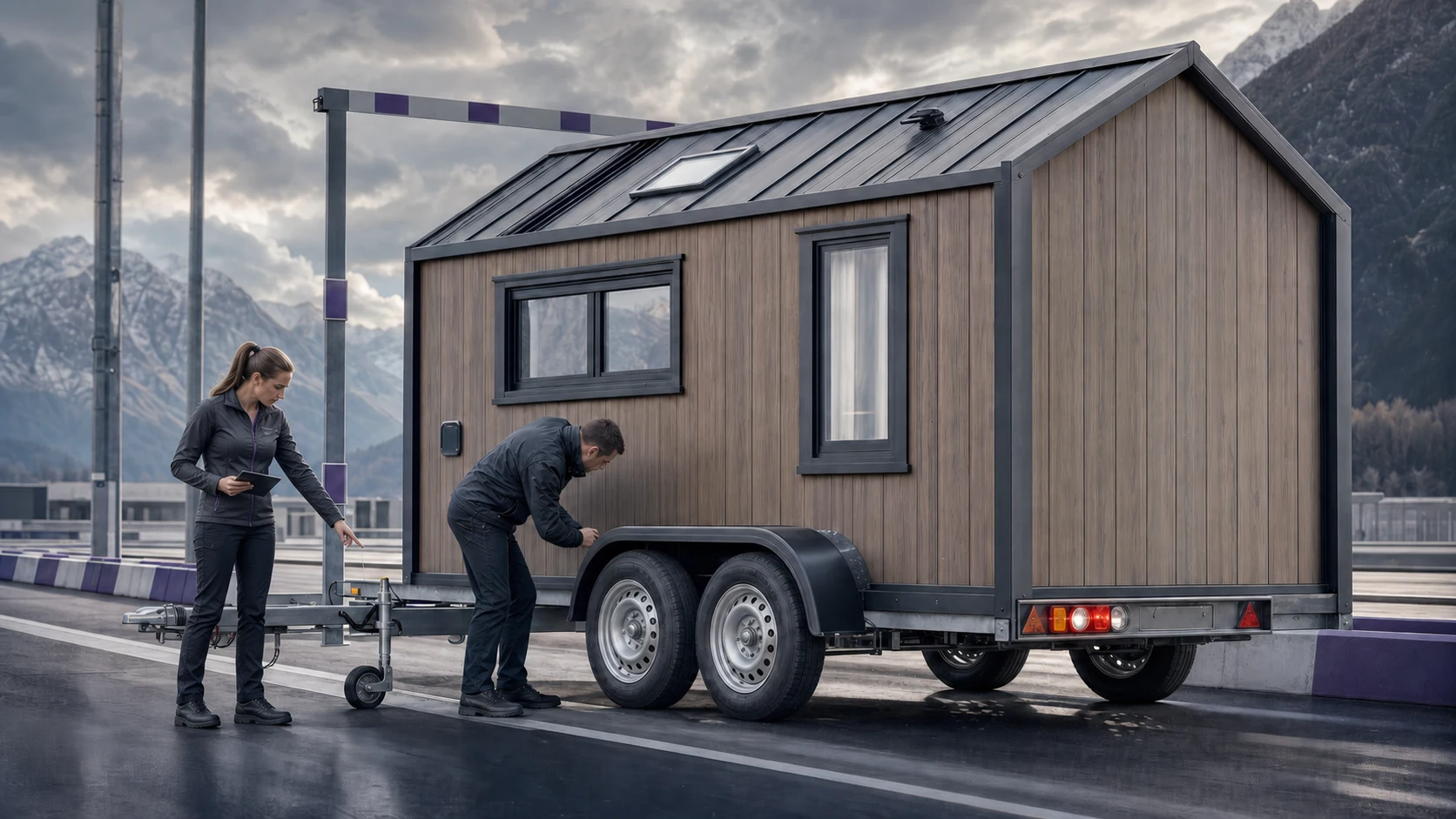
The term “tiny house” describes a compact living structure. Once that structure is built as a road-going trailer, however, the applicable vehicle type-approval requirements must also be met. This article explains what that entails.
What Is O2-Category Type Approval?
Category O2 covers trailers with a maximum laden mass above 750 kg and not exceeding 3,500 kg. O2-category type approval enables the manufacturer to issue the certificate of conformity required for the registration of these trailers. To issue that certificate, the manufacturer must hold the relevant vehicle type approval. (Reference: Regulation (EU) 2018/858.)
What Is Tiny House Trailer Type Approval and How Is It Obtained?
Most tiny house trailers on the market use a tandem-axle design, although single-axle versions also exist. The approval route is the same for both configurations, with limited differences in the applicable test criteria.
Type approval for a tiny house trailer is granted to manufacturers that meet the applicable EU or national requirements for series production of the vehicles concerned. It allows the manufacturer to place compliant production vehicles on the market and register them.
The steps involved in securing type approval for a tiny house trailer can initially appear complex. Professional engineering and consultancy support can make the process considerably easier. The applicant must first qualify as the vehicle manufacturer.
Becoming the manufacturer of a road-going trailer also means operating within the automotive regulatory framework. This brings defined quality-management requirements and administrative procedures. While key administrative documents such as the WMI allocation required for VIN assignment and trade mark registration are being completed, the prototype test vehicle is prepared in parallel.
Through technical guidance and training, our specialists help prepare both the prototype and future production vehicles for the applicable tests.
Once the vehicle has passed the tests conducted by accredited organisations, the technical documentation is submitted to the relevant approval authority.
The Approval Scope Is Critical
The scope of the approval is the key consideration. The broader the approved range of axles, couplings, lighting equipment, glazing and other variants, the longer the approval can support your product range. This is the approach we recommend.
A narrowly defined scope can lead to repeated extension or renewal costs. Product developments may also have to wait until those approval updates are completed.
The technical file should therefore be checked carefully before it is submitted to the approval authority.
Must an O2-Category Tiny House Trailer Be Registered?
In short, yes. O2-category vehicles must be registered for road use. The registration process therefore needs to be completed with the applicable series-production type approval and certificate of conformity.
Cost of Tiny House Trailer Type Approval
For information on TSE approval costs, see the official TSE page. Manufacturers planning to export often choose EU type approval. As of March 2024, the cost of a typical approval starts at EUR 5,000. Contact us to discuss the available commercial terms.
The total cost depends on the approval authority, technical service and scope of approval. Additional items may apply in either route, including TSE WMI allocation, trade mark registration, a production-capacity report and ISO 9001:2015 certification.
Where Is O2-Category Type Approval Obtained?
For approval projects involving O2-category trailers, caravans and tiny houses, we recommend discussing the intended product range with us at an early stage. Our team manages the technical and administrative work around the needs of the manufacturer and the project. Type approval for a tiny house trailer may be issued by a European approval authority or by the Turkish Standards Institution.
Timescales for O2-Category Type Approval
An O2-category type-approval project for a tiny house, caravan or trailer may involve an approval period of two to four months. The manufacturer’s readiness is the most important factor affecting this period. It includes completion of the administrative documents and preparation of the prototype test vehicle. At approval authorities, technical-file review can take between three and twelve weeks. Costs linked to these timelines vary from project to project. When committing to a delivery date, allow for your own preparation, testing and documentation work as well as the approval authority’s review.
To submit an online enquiry with details of your intended production, use the online form.
Overview
A tiny house used on public roads as a trailer is assessed against vehicle-category and type-approval requirements, regardless of how the structure is used at its destination. This article explains the principal requirements for category O2. The article also covers What Is O2-Category Type Approval?, What Is Tiny House Trailer Type Approval and How Is It Obtained? and The Approval Scope Is Critical.