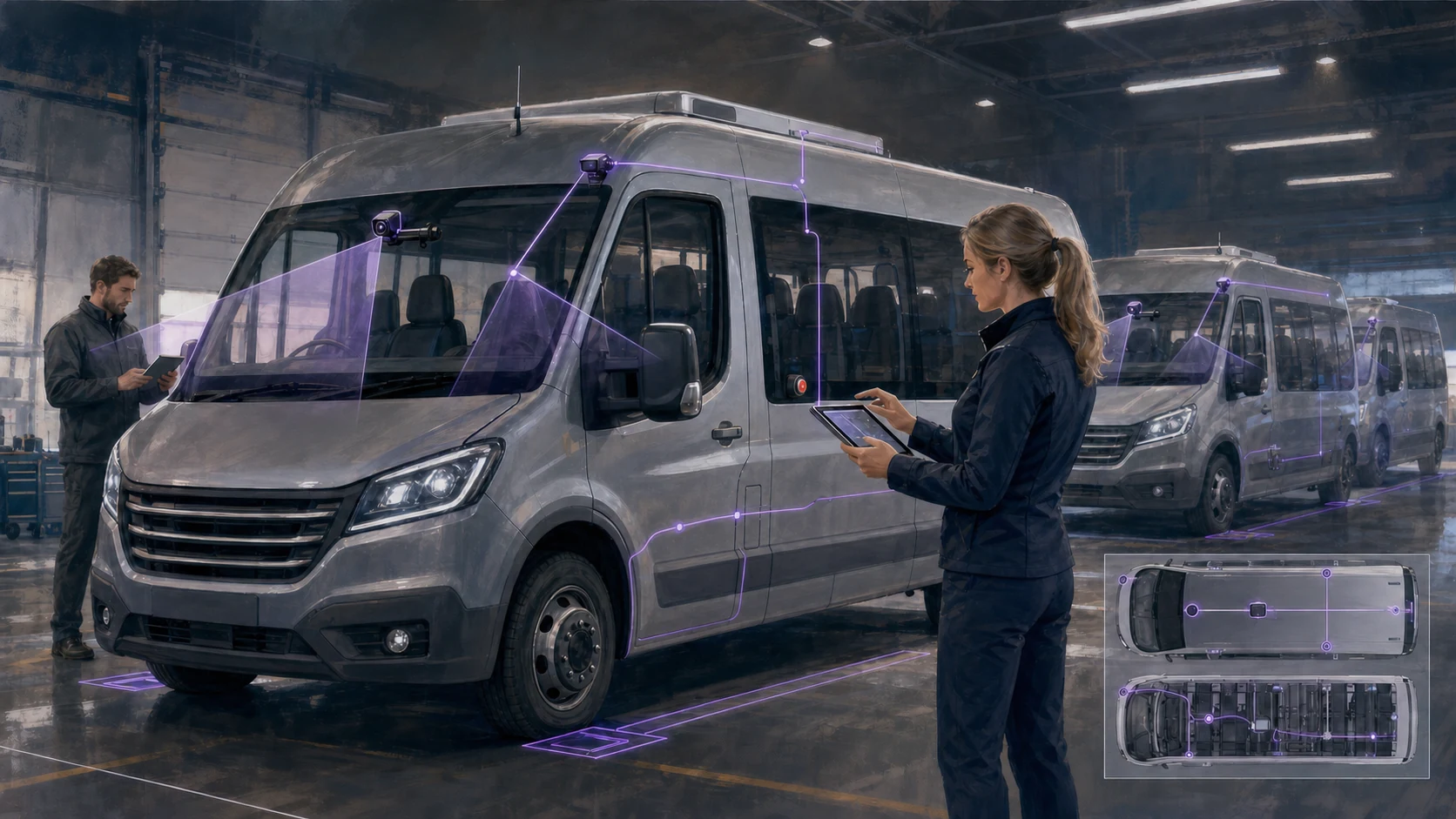
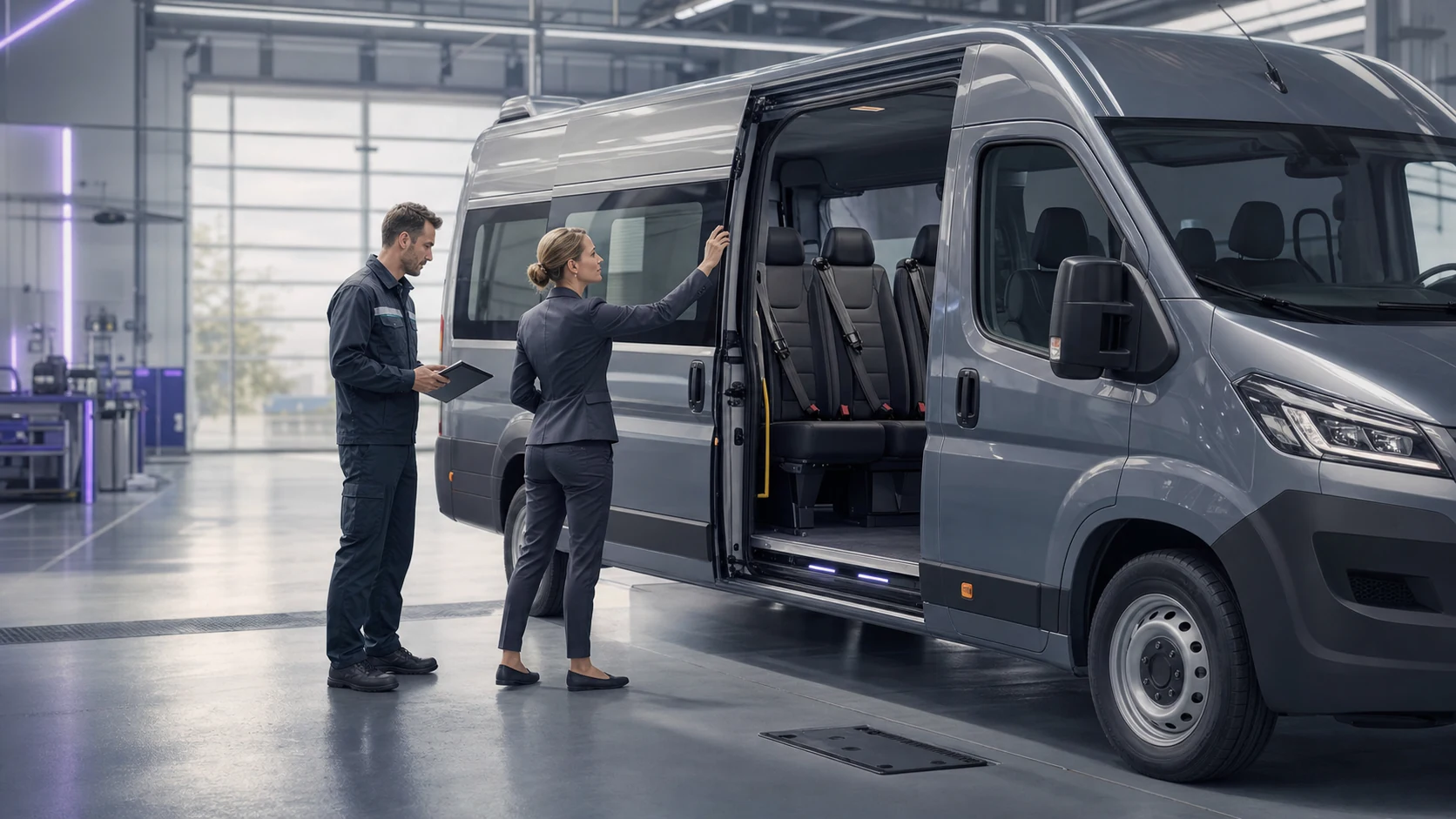
National and international legislation establishes the safety requirements for passenger vehicles. A manufacturer planning to produce an M2- or M3-category bus can follow several approval and production routes.
One route is to convert a panel van originally built for goods transport into a bus. Manufacturers entering passenger-transport vehicle production, as well as those already carrying out such conversions, need an approval strategy that reflects the base vehicle, conversion scope and intended market. This article explains the principal routes and the support available at each stage.
Definitions of M2- and M3-Category Buses
Buses are vehicles designed for passenger transport and must satisfy safety requirements established in EU and UN legislation. In Türkiye, the everyday term “minibüs” is also widely used, although the formal regulatory classification is based on vehicle category and class. The following explanation uses accessible language while retaining that regulatory distinction.
Buses fall within vehicle categories M2 and M3 and are further assigned to Classes I, II, III, A or B. The fundamental threshold is that the vehicle is designed to carry the driver and more than eight passengers.
Category M2 covers passenger vehicles with a maximum mass not exceeding 5,000 kg, while category M3 covers those with a maximum mass above 5,000 kg.
Class I covers vehicles carrying more than 22 passengers in addition to the driver, with areas intended for standing passengers and frequent movement. Class II primarily accommodates seated passengers but permits a limited number of standing passengers. Class III is designed exclusively for seated passengers. High-capacity urban buses are typical Class I vehicles, regional services commonly use Class II vehicles, and long-distance coaches are generally Class III.
Class A vehicles are designed to carry no more than 22 passengers in addition to the driver and include provision for standing passengers. Class B vehicles have the same passenger-number limit but are intended to carry seated passengers only. Accessible urban vehicles with wheelchair spaces and folding seats are typical Class A applications; shuttle buses, school buses and seated local services are common Class B examples.
Which Panel Vans Are Commonly Converted into Buses?
Buses converted from panel vans are widely used because the base vehicles can offer practical advantages in operation, fuel consumption, purchase cost and service availability.
Common base vehicles used for these conversions in Türkiye include Mercedes-Benz Sprinter, Fiat Ducato, Ford Transit, Peugeot Boxer, Citroën Jumper, Renault Master, Iveco, Volkswagen Crafter and MAN models. Demand for each platform varies according to factors such as customer preference, duty cycle and the region in which the vehicle will operate.
What Is a Panel Van? In practical terms, a panel van is an enclosed motor vehicle originally designed for carrying goods.
Which Approval Route Is Suitable for a Panel-Van Conversion?
Two approval routes are commonly considered for panel-van conversions. Depending on the base vehicle, production volume, target market and conversion scope, AİTM series-conversion type approval and multi-stage type approval under Regulation (EU) 2018/858 are generally the principal options.
Vehicles intended for export to the EU market need an approval route based on Regulation (EU) 2018/858. For projects aimed solely at the domestic market, a national type-approval route may be more appropriate once the target market and production plan have been assessed.
How Is Type Approval Obtained?
Vehicle type-approval programmes follow a broadly similar structure. As with O1- and O2-category approvals, agricultural-trailer approvals, and national approval projects, this approval route includes both administrative and technical requirements. Initial meetings define the intended scope, followed by a market assessment and confirmation of the production objective. The administrative and technical workstreams then progress in parallel.
The applicant must be an established company with an appropriate production site. Further eligibility requirements and company records may apply, and the quality-management arrangements must be prepared. While the administrative work is under way, the test programme is planned and the test vehicle is built or converted to the agreed specification.
How Are Bus Tests Conducted?
Buses are subject to demanding safety requirements. Legislation governs matters such as seat anchorage, passenger accommodation and superstructure strength. Depending on the vehicle class and approval scope, the programme may include tests in a laboratory, at the production site and on the road. Both the test specimens and the completed vehicle therefore need to be prepared against a coordinated test plan. We help define that plan, identify the required evidence and prepare the vehicle for each applicable assessment.
Initial Assessment and Conformity of Production
At the start of the type-approval programme, the production documentation and readiness of the manufacturing site are assessed. For an explanation of this requirement, read What Is Conformity of Production (CoP)?.
What Happens after Testing?
After the tests and initial assessment have been completed successfully, the accredited technical service reviews the submitted technical file. During preparation, we align the documentation with the manufacturer’s priorities and the agreed approval scope. The technical service then confirms the evidence and issues the relevant test reports. Those reports and supporting documents are submitted to the approval authority. If the administrative and technical reviews identify no outstanding non-conformities, the authority issues the type approval. The same sequence applies to both national and EU type approval.
What Happens after Type Approval Is Granted?
Once the approval authority issues the type approval, the manufacturer is authorised to produce vehicles within its approved scope. A certificate of conformity (CoC) is then issued for every compliant vehicle. Together with the invoice and other administrative records, the CoC supports the vehicle-registration process. A national series-conversion approval may also require a pre-registration inspection. Approval is not the end of the manufacturer’s obligations: the quality system must be maintained for every vehicle, production must be verified through surveillance activities, and product changes must be covered by an extension to the approval. Ongoing audits must demonstrate that the approved process remains effective. For further detail, see our article on the manufacturer’s obligations.
Why Anemon Engineering?
Anemon Engineering has successfully managed type-approval programmes for a number of established bus manufacturers. Our active involvement throughout these projects has given us practical experience across both domestic and international approval routes. We identify the manufacturer’s commercial and technical priorities, then structure the approval scope around the intended product and market. To discuss our services and how we can support your programme, contact us. For current industry updates, follow us on LinkedIn and Instagram.
Overview
M2- and M3-category bus projects must be assessed by considering passenger capacity, vehicle mass, intended use and safety requirements together. This article outlines panel-van conversions and the main differences between series and individual approval routes. The article also covers Definitions of M2- and M3-Category Buses, Which Panel Vans Are Commonly Converted into Buses? and Which Approval Route Is Suitable for a Panel-Van Conversion?.